inquiry
Leave A Message
If you are interested in our products and want to know more details,please leave a message here,we will reply you as soon as we can.
submit
Home

metal deburring robot

metal deburring robot

  • Why Should Foundries Choose Robotic Grinding Over Manual Grinding?
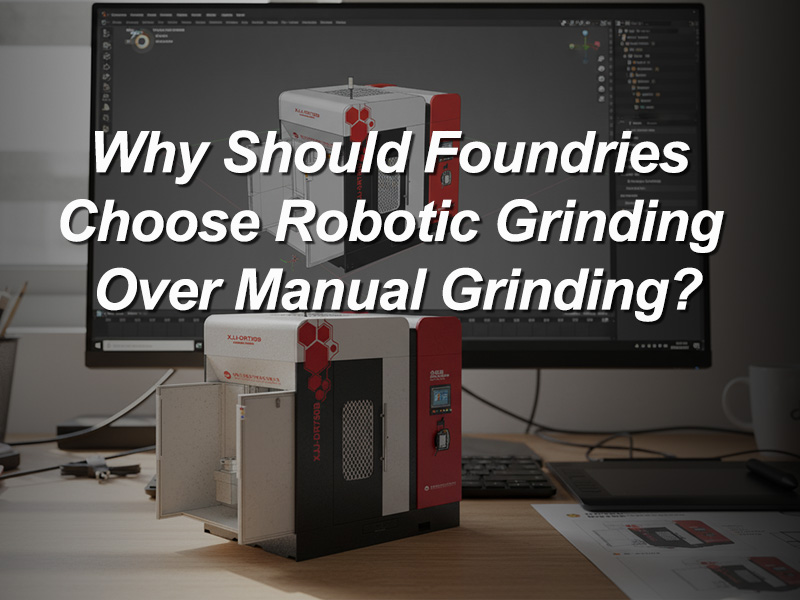
    Why Should Foundries Choose Robotic Grinding Over Manual Grinding?
    Dec 24, 2025
    Why Should Foundries Choose Robotic Grinding Over Manual Grinding? Grinding is a critical post-processing step in foundries that significantly impacts both the surface quality and performance of castings. While manual grinding has been the industry standard, it faces limitations in terms of speed, consistency, and precision. As automation technology evolves, more and more foundries are turning to robotic grinding solutions to address these challenges. Advantages of Robotic Grinding: Increased Production Efficiency: Unlike manual labor, robots can operate continuously 24/7, greatly improving throughput and reducing downtime. This boost in productivity helps foundries meet tight deadlines and respond faster to market demand. Consistent Quality and Precision: Robotic systems provide higher repeatability and precision. Robots do not experience fatigue or errors, meaning every cast is treated with the same accuracy, ensuring consistent surface quality and dimensional accuracy across batches. Handling Complex Parts: Manual grinding often struggles with intricate shapes or difficult-to-reach areas. Robotic systems, however, excel at handling complex geometries thanks to advanced multi-axis capabilities, ensuring thorough grinding of even the most challenging castings. Conclusion: Given the increased efficiency, improved consistency, and ability to handle complex tasks, robotic grinding presents a clear advantage over manual grinding in foundries. As automation continues to revolutionize the industry, adopting robotic grinding will be crucial for maintaining competitive edge.
    Read More
  • Human-Robot Collaboration: The Most Practical Path for Automated Grinding Today
    Human-Robot Collaboration: The Most Practical Path for Automated Grinding Today
    Dec 01, 2025
    Human-Robot Collaboration: The Most Practical Path for Automated Grinding Today Many customers ask, “Can we achieve fully unmanned grinding?” The reality is: full automation isn’t feasible yet. The most effective approach today is human-robot collaboration.  1.Why Is Full Automation Difficult?   Castings vary in deformation, batch differences, and irregular flash shapes. Robots excel at repetition, not judgment. 2.Human-Robot Collaboration Is More Efficient The optimal workflow: manual loading/unloading, NEVIEW robots handling the main grinding paths, and humans handling the few ultra-complex areas. 3.Robots Handle the Standardized 80% NEVIEW’s high-rigidity robotic arm and automatic path correction cover most standardized zones effectively.  4.Safety Benefits Are Underrated   Dust, noise, and vibration can harm workers. Robots isolate these hazards inside a fully enclosed safety cell. 5.More Predictable ROI   With faster deployment and lower risk, this model offers predictable ROI and is widely accepted in global factories. Real automation isn’t about replacing people — it’s about letting humans and robots each do what they do best. NEVIEW’s automation solutions are helping foundries worldwide achieve more stable and modern production.
    Read More
  • Smart Grinding for Aluminum Die-Cast Parts: Boosting Efficiency and Quality
    Smart Grinding for Aluminum Die-Cast Parts: Boosting Efficiency and Quality
    Nov 17, 2025
    Smart Grinding for Aluminum Die-Cast Parts: Boosting Efficiency and Quality   Aluminum die-cast parts are prone to deformation and sharp edges. Manual grinding is time-consuming and may generate defective products. NEVIEW smart grinding robots use high-precision laser detection and force-control systems to identify burrs and workpiece geometry, dynamically adjusting angles and pressure for precise deburring and smooth surfaces. Automated systems complete multi-angle grinding in one fixture, increasing throughput by 30–50% while reducing labor costs. With data monitoring and smart path optimization, manufacturers achieve consistent quality, stable production, and energy efficiency. Applications: automotive parts, home appliance aluminum parts, and industrial aluminum castings.  
    Read More

leave a message

leave a message
If you are interested in our products and want to know more details,please leave a message here,we will reply you as soon as we can.
submit
Contact Us: judy@ahxjj.cn

home

products

WhatsApp

Contact Us