inquiry
Leave A Message
If you are interested in our products and want to know more details,please leave a message here,we will reply you as soon as we can.
submit
Home

Cast Grinding Machine

Cast Grinding Machine

  • Failure Analysis and Countermeasures for Automated Deburring of Die Castings
    Failure Analysis and Countermeasures for Automated Deburring of Die Castings
    Sep 03, 2026
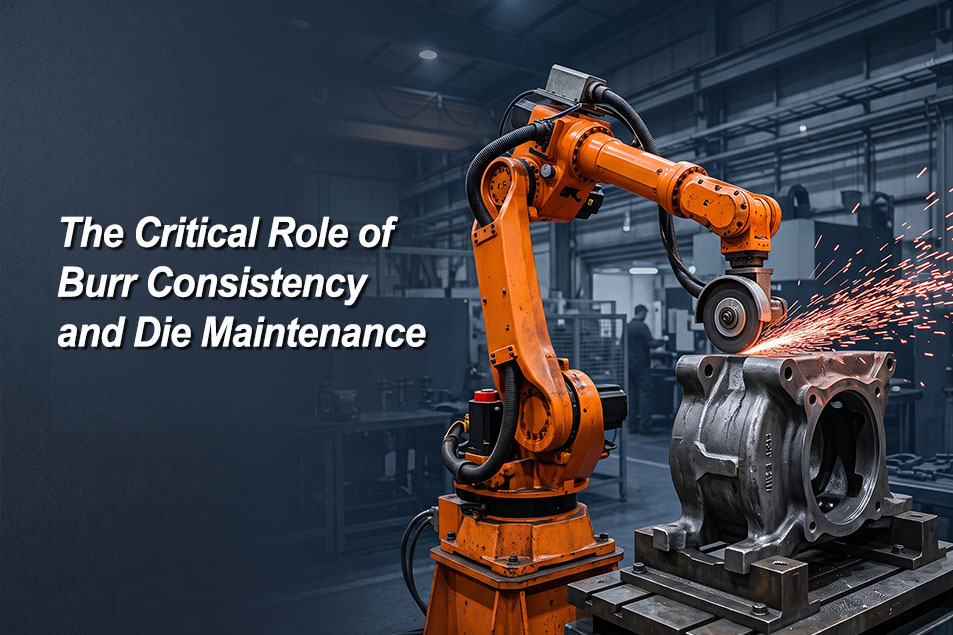
    Failure Analysis and Countermeasures for Automated Deburring of Die Castings AbstractAutomated deburring of die castings is theoretically considered easier to implement than for iron or steel castings because die castings have better surface quality and burrs are concentrated at relatively fixed locations such as parting lines, gates, vents, and ejector pin marks. However, actual operating data from multiple die casting shops show that robot deburring cells commonly experience missed spots, over-grinding, tool collisions, and yield degradation after only three to six months of production, with some equipment eventually idled or reverted to manual operation. This article analyzes the process characteristics of die casting production and identifies three core factors causing automation failure: burr size variation due to die wear, lack of reliable positioning datums on raw parts, and insufficient deburring tool management. The study argues that the prerequisite for successful die casting deburring automation is not higher robot accuracy or faster force control response, but rather the establishment of a preventive die maintenance system, reliable workpiece positioning solutions, and closed-loop tool life management. The article concludes with improvement paths and implementation recommendations for different die casting production scenarios. Keywordsdie casting deburring automation; burr consistency; die wear; positioning datum; tool management 1 IntroductionDie casting produces parts with relatively high dimensional accuracy, good surface finish, and fast cycle times, widely used in automotive, telecommunications, power tools, and home appliance industries. After ejection, die castings typically require removal of gates, vents, flash, and ejector pin protrusions, collectively referred to as burrs. Manual deburring has long relied on pneumatic files, rotary burrs, and sandpaper, with high labor intensity, obvious dust and noise hazards, and poor consistency. Therefore, the die casting industry has a strong practical demand for deburring automation. From a technical perspective, burr positions on die castings are relatively fixed, theoretically making them suitable for automated removal by robots with floating tools. However, in actual projects, many die casting plants have invested hundreds of thousands or even millions of RMB in robot deburring cells, only to encounter various problems after a few months of operation: some products show rising missed-spot rates requiring full manual inspection and repair; some suffer over-grinding leading to scrap; some experience frequent tool collisions causing spindle damage. These problems erode management confidence in automation, and equipment gradually sits idle. This article analyzes the deep causes of die casting deburring automation failure based on investigations and project reviews in multiple die casting shops. The analysis is not limited to the robot itself but covers die casting molds, raw part condition, positioning methods, tool consumption, and on-site management, aiming to provide actionable improvement directions for die casting plants. 2 Burr Size Variation: The Direct Consequence of Die WearBurrs on die castings primarily form at the parting surface. Die casting molds are subjected to alternating clamping force and thermal stress from high-speed, high-pressure molten metal injection, causing wear, edge collapse, and localized depression on the parting surface. New molds or freshly repaired molds have tightly closed parting surfaces, with flash thickness typically between 0.1 mm and 0.3 mm—thin and uniform, allowing robots to remove it stably with fixed trajectories and minimal floating compensation. But as mold usage accumulates, the parting surface gap gradually increases, and flash thickness can grow from 0.3 mm to over 1 mm, sometimes exceeding 2 mm in severe local areas. This variation in burr thickness is devastating to robot deburring. Under fixed trajectory mode, the robot follows preset paths and pressure. When burrs suddenly thicken, if the force control system does not respond quickly enough, the tool will either over-cut the workpiece body or under-cut the burr. Even with force-controlled spindles, response time is typically in the tens of milliseconds, offering limited adaptability to sudden burr changes. Moreover, if force control parameters are set too sensitively, vibration occurs even in normal burr areas, affecting surface quality. The fundamental solution is die maintenance. Die casting plants should establish a preventive die maintenance system, incorporating parting surface flatness inspection into daily checks. Specific practices include: inspecting parting surface wear every certain number of shots (e.g., 5,000 to 10,000 shots, depending on product size and alloy type), measuring parting surface gap with feeler gauges, repairing collapsed edges by welding and grinding, and promptly replacing worn inserts and ejector pins. The goal is to control burr thickness within a preset range, such as no more than 0.5 mm. Only when burr size is stable can robot trajectories and force control parameters remain effective over the long term. 3 Lack of Positioning Datum: Strict Requirements on Raw PartsRobot deburring demands far higher workpiece positioning accuracy than manual work. Manual operators can watch the workpiece and adjust file angles accordingly, while robots rely on preset coordinate systems. If the workpiece is not placed in a consistent position each time, the robot grinding trajectory will deviate from the actual burr location. Die cast raw parts usually enter deburring directly without machining, lacking precision datum surfaces. Fixtures often locate on raw surfaces, ejector pin bosses, gate stubs, or sidewall profiles. These features have draft angles, ejection deformation, and position deviations. For example, ejector pin boss height may vary due to ejector mechanism wear, gate stub length differs due to injection parameter fluctuations, and raw surfaces warp from uneven shrinkage. These accumulated deviations can cause the actual workpiece position on the fixture to differ from the theoretical position by 0.5 mm to 2 mm. For deburring processes requiring accuracy within 0.3 mm, such positioning error is unacceptable. There are several ways to solve the positioning problem. First, control the tolerances of key locating features at the die casting stage, such as designing dedicated locating bosses on the mold and stabilizing their dimensions through injection parameters. Second, add a simple machining operation before deburring to mill a flat datum or drill a locating hole, providing a stable reference for the robot. Third, use vision guidance for rough position compensation, where cameras recognize workpiece contours or feature points, calculate offsets, and correct robot trajectories. Vision solutions face interference from oil, reflections, and surface oxidation color differences in die casting shops, and their recognition stability still needs improvement, making them more suitable as auxiliary means rather than the sole dependency. 4 Lack of Tool Management: An Open-Loop System Causes Yield DecayDie castings are primarily aluminum and zinc alloys with relatively low hardness, but rotary burrs, grinding discs, and flap wheels still wear. Aluminum has a special problem: aluminum chips tend to adhere to tool surfaces, forming built-up edges that reduce cutting efficiency and scratch workpiece surfaces. If tool condition is not managed, robot deburring quality gradually declines with running time, dropping from initial pass rates above 95% to 80% or lower. Most die casting plants pay insufficient attention to tool management. In manual deburring, workers judge tool sharpness by feel and replace dull tools casually without cost awareness. But once a robot deburring cell is established, tool replacement must be institutionalized. Without tool life records and condition monitoring, the robot becomes an open-loop system: inputs are raw parts and tools, output is the deburred workpiece, but there is no feedback in between, and quality decay cannot be detected in time. Improvement measures include: establishing a tool life statistics table recording the number of parts ground and replacement time for each tool; monitoring spindle current trends and prompting tool replacement when current drops significantly or fluctuates abnormally; for high-volume products, configuring automatic tool changers or multi-station tool magazines to reduce manual intervention. Tool costs should be included in the operating cost accounting of the automation system, and die casting plants must not ignore this item when calculating return on investment. 5 Application Scenario Analysis and Implementation RecommendationsDie casting deburring automation is not suitable for every product. Conditions favoring automation include: single product with high volume, annual output exceeding 50,000 pieces; a sound die maintenance system with controlled burr thickness variation; burr positions concentrated in robot-reachable areas; and product geometry allowing reliable positioning; product design tolerating certain deburring variation. For multi-variety small-batch production or severely worn dies, blindly adopting robot deburring carries high risk. It is better to start with local automation on the most regular and concentrated burr locations, such as gate sawing or parting line grinding, while keeping other areas manual and transitioning gradually. Before investment, conduct a burr consistency test: collect burr height data from at least three batches with thirty pieces per batch, calculate mean and standard deviation, and use the results to set trajectory compensation amounts and force control parameters. 6 ConclusionThe main reason die casting deburring automation fails is not immature robot technology but insufficient process stability. The solution path must address die maintenance, raw part positioning, and tool management to establish a closed-loop control system. Only when burr size variation is controlled, positioning is reliable, and tool condition is manageable can robot deburring achieve long-term stable operation. Die casting plants should include die maintenance costs and tool management costs in total investment evaluation when making automation decisions, avoiding the mistake of only calculating equipment purchase price while ignoring operating costs.
    Read More

  • Eliminating Downtime: How Offline Programming (OLP) and Digital Twins Enable Seamless Job Changeovers in Robotic Grinding
    Eliminating Downtime: How Offline Programming (OLP) and Digital Twins Enable Seamless Job Changeovers in Robotic Grinding
    Aug 18, 2026
    Eliminating Downtime: How Offline Programming (OLP) and Digital Twins Enable Seamless Job Changeovers in Robotic Grinding For many small-to-medium foundries operating under high-mix, low-volume (HMLV) production models, the primary hesitation when considering grinding automation is: "With our diverse product portfolio, if every job changeover requires hours or days of line downtime for re-programming, overall productivity will actually drop." Traditional hand-teaching or online programming indeed consumes precious cell runtime. However, the integration of Offline Programming (OLP) and Digital Twin technologies has completely resolved this operational bottleneck: Zero-Downtime Virtual Programming: Engineers import the 3D CAD models of castings directly into the OLP environment. Within a virtual simulation, the software automatically detects parting lines, flash, and burrs, generating optimized toolpaths and spindle orientations. The entire programming cycle takes place 100% in the background without stopping the active robot cell. Collision Detection and Cutting Simulation: The digital twin predicts cutting dynamics, joint limit reachability, and potential fixture interferences prior to execution, ensuring that uploaded programs are 100% safe and execution-ready. Near-Instant Job Changeover: When transitioning production to a new casting part number, operators simply load the pre-configured offline program via the HMI touchscreen. The grinding robot resumes operation within seconds. Powered by NEVIEW's intelligent software suite, foundries with highly variable product lines can now fully unlock the speed, repeatability, and flexibility of modern robotic finishing.
    Read More
  • Building a Green, ESG-Compliant Foundry: Full Enclosures and Dust Control in Modern Robotic Grinding
    Building a Green, ESG-Compliant Foundry: Full Enclosures and Dust Control in Modern Robotic Grinding
    Aug 17, 2026
     Building a Green, ESG-Compliant Foundry: Full Enclosures and Dust Control in Modern Robotic Grinding  In today's global industrial landscape, ESG (Environmental, Social, and Governance) principles and green manufacturing are no longer distant slogans—they represent mandatory regulatory mandates directly impacting foundries worldwide. For decades, traditional casting grinding shops have been labeled as hazardous, high-pollution facilities due to deafening noise, airborne metallic dust, and elevated workplace injury risks, acting as severe stumbling blocks to green transitions. Implementing NEVIEW Fully Enclosed Robotic Grinding Workstations provides far more than capacity expansion; it is the ultimate pathway for foundries to upgrade into modern, eco-friendly smart facilities:   100% Source Dust Capture for a Zero-Dust Workspace (Environmental Focus): Manual grinding allows dangerous metallic particles to scatter uncontrollably. NEVIEW workstations feature fully enclosed heavy-duty acoustic enclosures operating under continuous negative pressure. Integrated with spark arrestors and explosion-proof dust collectors, the system captures and filters 100% of metallic dust right at the source, eliminating dust explosion hazards and dramatically improving air quality.   Drastic Shop-Floor Noise Suppression: Heavy acoustic enclosure walls suppress deafening grinding noise exceeding 100 dB down to below 80 dB, bringing the facility in full compliance with global occupational health standards.   Protecting Human Health and Safety (Social Focus): The true value of automation lies in its respect for worker well-being. When grinding robots take over hazardous deburring tasks, human operators move to safe, climate-controlled rooms to oversee system operations. This completely eradicates severe risks like pneumoconiosis, Vibration White Finger (VWF), and projectile injuries. Embracing green grinding automation empowers foundries to navigate strict environmental codes effortlessly while solidifying a responsible corporate image globally—securing long-term orders from blue-chip international buyers who prioritize ESG compliance.
    Read More
  • Manual Teaching vs. Smart Force Control: How Foundries Choose the Right Robotic Grinding Solution
    Manual Teaching vs. Smart Force Control: How Foundries Choose the Right Robotic Grinding Solution
    Aug 14, 2026
    Manual Teaching vs. Smart Force Control: How Foundries Choose the Right Robotic Grinding Solution Investing in a grinding robot system represents a major capital expenditure decision for any foundry embarking on its modernization journey. However, with diverse automation options on the market, many facilities fall into the trap of purchasing equipment they cannot operate effectively. When evaluating robotic solutions, foundries must choose the right system based on part complexity, shop environment, and technical capacity: 1. Manual Teaching Grinding Robots (Foolproof Operation, Rugged & Cost-Effective) For many small-to-medium foundries or facilities lacking dedicated, high-cost robotics programmers, NEVIEW Manual Teaching Grinding Robots offer an ideal, practical solution:   Zero Programming Barrier: Operators do not need to write complex code. A 50-year-old shop technician can hand-guide the robot once using a teach handle; the robot then perfectly replicates the skilled worker's motions in just 5 minutes 。   Superior Dust Resistance & Durability: By omitting delicate 3D optical cameras that often clog or fault in heavy metallic dust environments, these systems deliver high mechanical rigidity and virtually zero maintenance overhead.   Rapid Return on Investment: Without expensive software licensing fees, the initial CapEx is minimized, enabling foundries to recoup their investment in as little as 8 to 12 months. 2. Active Force Control & 3D Vision Systems (For Complex Parts & Premium Quality) For high-volume, highly complex castings with inconsistent burrs (such as engine blocks, wind turbine hubs, or hydraulic valves):   Adaptive 3D Vision: Conducts millisecond-level point-cloud scans prior to grinding, dynamically compensating for casting dimensional variations without expensive precision fixtures.   Active Force Control: Integrated end-of-arm torque sensors (constant-force floating heads) "feel" surface contours in real-time, dynamically adjusting pressure within microseconds to eliminate over-cutting and surface gouges. Essential System Architecture Factors   Process Setup: Select either Part-to-Tool (robot holds small-to-medium castings against fixed belt grinders) or Tool-to-Part (robot manipulates heavy grinders to process fixed multi-ton castings) based on part weight.   Protection Rating: Ensure the industrial robot body and end-of-arm spindles carry at least an IP67 protection rating to guarantee long-term reliability amidst abrasive metal dust.
    Read More
  • Unlocking the Potential of Grinding Robots: How Neview Helps Foundries Transform and Upgrade
    Unlocking the Potential of Grinding Robots: How Neview Helps Foundries Transform and Upgrade
    Jul 01, 2026
    Unlocking the Potential of Grinding Robots: How Neview Helps Foundries Transform and Upgrade Against the backdrop of the global manufacturing industry's accelerated transformation towards intelligence, foundries are facing unprecedented opportunities and challenges. As a key equipment for intelligent manufacturing, Neview's grinding robots provide strong support for foundries to unlock the potential of grinding robots and achieve transformation and upgrade. Through its advanced eight - axis seven - linkage structure, Neview's grinding robots achieve highly automated and precise grinding operations. This structure allows the robot to move freely on the surface of complex castings and complete various complex grinding tasks, greatly reducing manual intervention and improving the stability of production efficiency and product quality. At the same time, the high - speed operation and precise positioning capabilities of the robot significantly shorten the grinding time, meeting the large - scale production needs of foundries. The intelligent programming and teaching functions are another outstanding feature of Neview's grinding robots. Operators can make the robot learn and repeat complex grinding paths and actions simply through programming or manual teaching. This function not only reduces the technical threshold for operators but also improves programming efficiency, enabling foundries to quickly respond to market demands and produce diverse products. For example, when a foundry receives a new casting order, the operator can quickly set the grinding program for the robot through the teaching function. Without complex programming knowledge, the robot can be put into production. In addition, Neview's grinding robots also have powerful data analysis and optimization capabilities. It can collect various data during the grinding process in real - time, such as grinding force, speed, temperature, etc., and conduct in - depth analysis of these data through data analysis algorithms. Based on the analysis results, the robot can automatically adjust the grinding parameters and optimize the grinding process, further improving the grinding quality and efficiency. At the same time, foundry managers can understand the bottlenecks and problems in the production process through data analysis and take timely measures for improvement, achieving continuous optimization of the production process. Neview's grinding robots also focus on integration with the existing production systems of foundries. It can seamlessly connect with the foundry's automated production lines, logistics systems, etc., realizing the intelligence and integration of the entire production process. This not only improves production efficiency but also reduces manual operations in intermediate links, reducing the possibility of errors and enhancing the overall competitiveness of the foundry.
    Read More
  • The Future of Foundries: Moving Forward with Neview Grinding Robots
    The Future of Foundries: Moving Forward with Neview Grinding Robots
    Apr 30, 2026
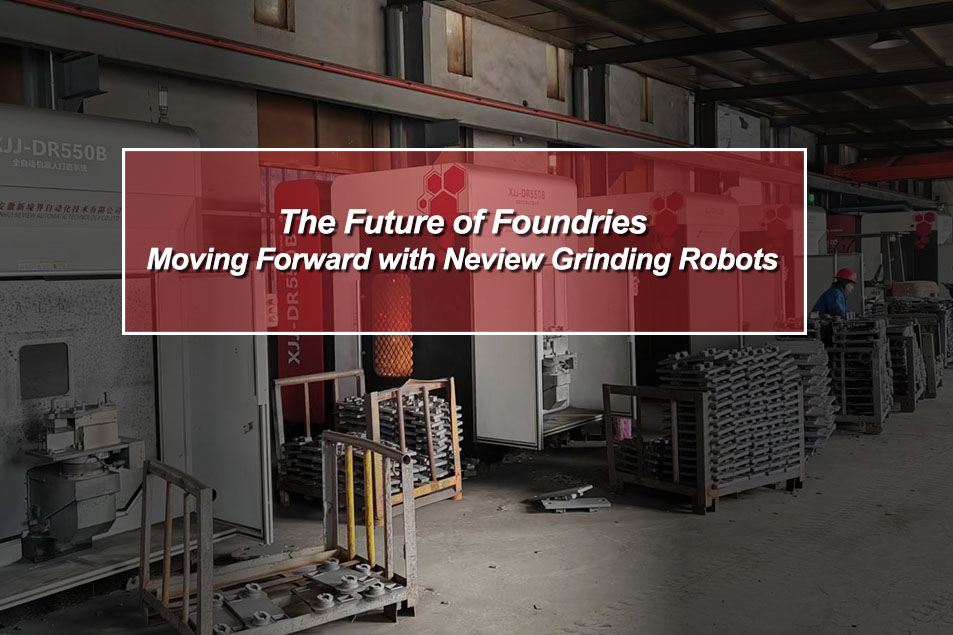
    The Future of Foundries: Moving Forward with Neview Grinding Robots With the rapid development of technology, the foundry industry is facing unprecedented changes. In this transformation, the grinding robots of Anhui Neview Automatic Technology Co., Ltd. are leading foundries towards a more intelligent and efficient future.   Neview grinding robots provide comprehensive solutions for foundries with their leading technology. From the high - precision grinding of complex castings to the powerful deburring of large castings, the robots are fully capable. Its unique eight - axis seven - linkage structure endows the robot with extremely high flexibility and precision, enabling it to perform meticulous operations on the surfaces of various complex castings, ensuring that every detail is perfectly processed.   The intelligent compensation and flexible fitting technology is the key for Neview grinding robots to adapt to diverse castings. When facing castings of different materials and shapes, the robot can achieve flexible grinding by intelligently controlling the current loop, position loop, and torque loop. This self - adapting ability enables the robot to efficiently complete grinding and deburring tasks without damaging the castings. Operators only need to make simple parametric modifications to enable the robot to quickly adapt to new types of castings, greatly improving the flexibility and efficiency of production.   The automatic error detection and compensation system is the core technology of Neview grinding robots to ensure quality. During the casting process, castings inevitably have some dimensional and shape errors. Neview grinding robots detect these errors in real - time through displacement sensors, quickly calculate in the background, and automatically correct the grinding path, ensuring that regardless of the errors of the castings, they can be accurately ground and deburred. This technology has greatly improved the stability of product quality, winning the trust and reputation of customers for foundries.   In addition to technological advantages, Neview also provides foundries with comprehensive service support. From pre - project equipment selection consultation to installation and commissioning, and then to later maintenance and technical upgrades, Neview's professional team always closely cooperates with foundries to ensure that the grinding robots can operate continuously and stably, creating maximum value for foundries.   Looking to the future, foundries
    Read More

leave a message

leave a message
If you are interested in our products and want to know more details,please leave a message here,we will reply you as soon as we can.
submit
Contact Us: judy@ahxjj.cn

home

products

WhatsApp

Contact Us