Jun 18, 2026
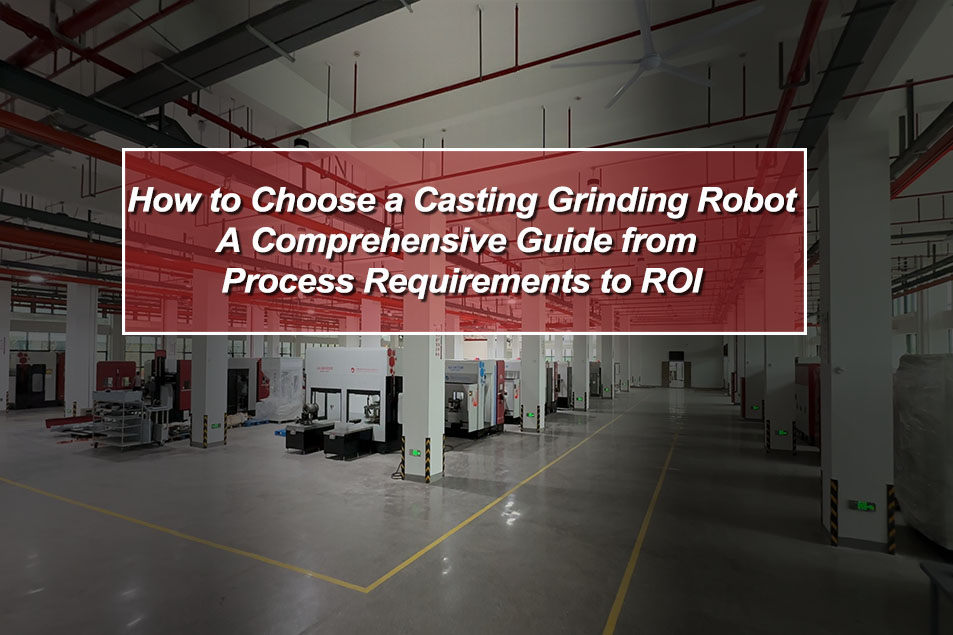
How to Choose a Casting Grinding Robot: A Comprehensive Guide from Process Requirements to ROI
As manufacturing industries worldwide continue to accelerate automation and digital transformation, foundries are facing increasingly complex operational challenges.
On one hand, skilled grinding workers are becoming harder to recruit and retain. On the other hand, customers are demanding higher levels of product consistency, shorter lead times, and improved quality standards. At the same time, rising labor costs, stricter environmental regulations, and workplace safety requirements are putting additional pressure on traditional manual grinding operations.
As a result, more foundries are evaluating Casting Grinding Robots as a practical solution for improving productivity, quality, and long-term competitiveness.
However, selecting the right robotic grinding system is not a simple task. Different foundries produce different casting types, operate under varying production volumes, and require unique finishing processes. Understanding how to choose the right system is therefore a critical step in any automation strategy.
Current Industry Challenges
Despite significant advancements in manufacturing technology, many foundries still rely heavily on manual or semi-automated grinding processes.
Several common challenges continue to affect the industry.
Rising Labor Costs
Labor costs have increased steadily over the past decade. Grinding operations are physically demanding and often involve harsh working environments, making it difficult to attract younger workers.
Inconsistent Product Quality
Manual grinding relies heavily on operator experience and skill levels.
As a result, manufacturers often encounter:
Over-grinding
Under-grinding
Surface inconsistency
These issues can negatively affect downstream machining and final product quality.
Workplace Safety Risks
Grinding operations typically generate:
Dust
Noise
Flying sparks
Long-term exposure to these conditions may increase occupational health risks and safety concerns.
Limited Productivity
Manual operations are constrained by workforce availability and working hours, making it difficult to scale production efficiently during periods of high demand.
Technology Analysis
Components of a Robotic Grinding System
A modern Robotic Grinding System typically consists of:
Industrial robot
Grinding spindle
Force control system
Vision system
Fixtures and tooling
Dust collection system
These components work together to achieve stable and repeatable grinding performance.
Force Control Technology
Grinding quality is highly dependent on contact force.
Advanced force control systems enable robots to:
Maintain constant pressure
Compensate for tool wear
Improve surface finish consistency
This significantly enhances process stability.
Machine Vision Technology
For castings with dimensional variations, machine vision systems can provide:
Automatic positioning
Deviation compensation
Path correction
This reduces manual intervention and improves accuracy.
Advantages of Eight-Axis Seven-Linkage Technology
Compared with conventional five-axis or six-axis solutions, eight-axis seven-linkage systems offer:
Larger working envelopes
Greater motion flexibility
Higher grinding coverage
Better adaptability to complex castings
These advantages are particularly valuable when processing large and geometrically complex components.
Application Scenarios
Steel Casting Grinding
Steel castings often have high hardness levels and significant riser or flash removal requirements.
Robotic systems can provide:
Accurate path control
Stable material removal
Consistent surface quality
Iron Casting Fettling
For pumps, valves, and pipeline components, robotic grinding enables efficient batch production while maintaining quality consistency.
Aluminum Die Casting Deburring
Industries such as electric vehicles, telecommunications, and industrial equipment require high-quality surface finishing.
Robotic grinding systems can effectively handle:
Flash removal
Parting line cleanup
Surface finishing
while maintaining dimensional consistency.
Business Benefits
Improved Productivity
Automated grinding cells can operate continuously with minimal interruptions.
Many implementations achieve productivity improvements ranging from 30% to 150%.
Reduced Labor Dependency
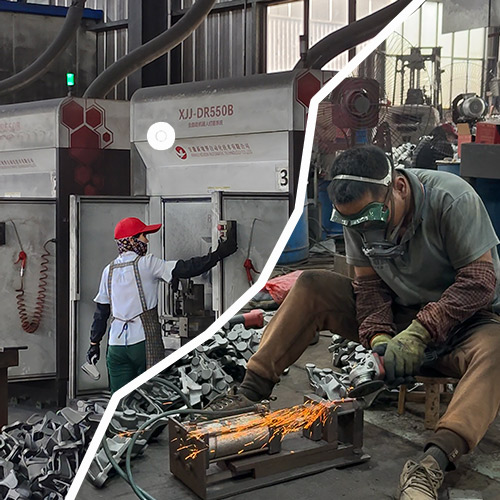
A single robotic grinding workstation can often replace two to six manual grinding operators, helping manufacturers address labor shortages.
Enhanced Product Quality
Program-controlled operations deliver highly repeatable grinding results, reducing variation and rework.
Better Workplace Safety
Workers can be relocated away from hazardous grinding environments, significantly improving workplace safety.
Data-Driven Manufacturing
Automation systems can collect valuable production data, including:
Output metrics
Equipment status
Process parameters
These capabilities provide a foundation for smart manufacturing initiatives.
Future Trends in the Next 3–5 Years
Several trends are expected to shape the future of foundry automation.
AI-Powered Robotics
Artificial intelligence will enable robots to make more adaptive decisions and optimize grinding processes automatically.
Standardized Intelligent Grinding Cells
Pre-engineered grinding workstations will become increasingly common due to their faster deployment and scalability.
Digital Foundries
Grinding systems will become more deeply integrated with MES, ERP, and factory management platforms.
Unmanned Fettling Workshops
Fully automated workflows—from casting transfer to grinding and inspection—will become more practical and economically viable.
Flexible Manufacturing
Future robotic systems will need to support high-mix, low-volume production environments while maintaining efficiency.
Conclusion
Automation is rapidly evolving from an optional investment into a strategic necessity for foundries seeking long-term competitiveness.
When selecting a Casting Grinding Robot, manufacturers should carefully evaluate:
Casting types
Process requirements
Automation objectives
System scalability
Expected return on investment
A well-planned automation strategy can help foundries improve efficiency, enhance quality, reduce labor dependence, and build a stronger foundation for future growth.
Read More




 IPv6 network supported