Mar 26, 2026
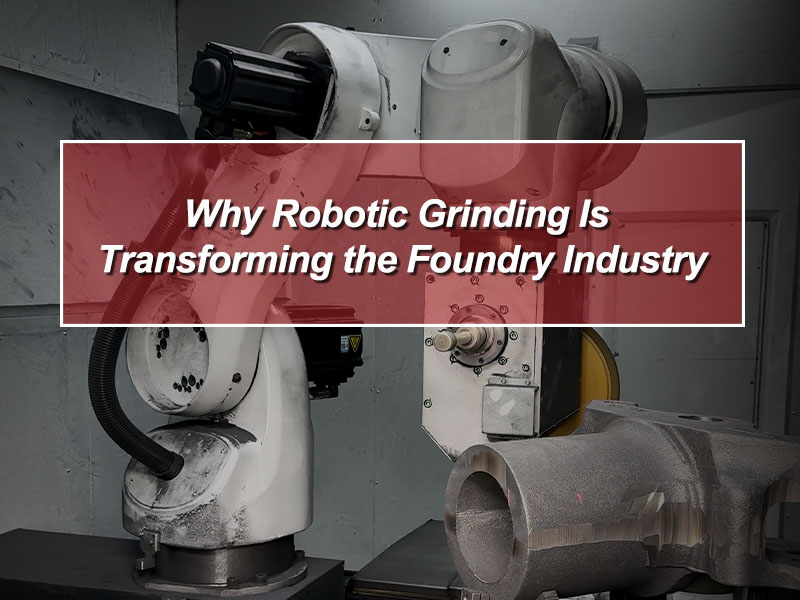
Why Robotic Grinding Is Transforming the Foundry Industry
1. Introduction: The Hidden Bottleneck in Foundry Production
In many foundries, grinding is still treated as a secondary or finishing operation. However, from an engineering and production standpoint, this perception is outdated. Grinding is not just about aesthetics—it directly affects product quality, dimensional accuracy, and customer acceptance.
In fact, grinding is often the final step where defects are identified, tolerances are corrected, and surface standards are achieved. Any inconsistency at this stage directly translates into product rejection or rework.
2. The Structural Limitations of Manual Grinding
Manual grinding has been the industry standard for decades, but it comes with inherent limitations:
Operator-dependent quality
High physical labor intensity
Exposure to dust and noise
Lack of process standardization
Difficulty in maintaining consistent cycle time
Even highly skilled workers cannot maintain identical performance over long shifts. This introduces variability that is difficult to control and nearly impossible to quantify.
3. What Makes Robotic Grinding Different
Robotic grinding systems fundamentally change how the process is executed. Instead of relying on human experience, they rely on programmable parameters and repeatable motion control.
Key advantages include:
Consistent force control
Repeatable trajectories
Stable cycle times
Data traceability
Integration with upstream and downstream processes
This transforms grinding from an “art” into a controlled engineering process.
4. ROI Perspective: Short-Term Cost vs Long-Term Gain
One of the most common concerns among foundry managers is the upfront investment required for robotic systems. However, this needs to be evaluated from a lifecycle perspective.
Cost savings typically come from:
Reduced labor dependency
Lower defect rates
Increased throughput
Reduced rework and scrap
Improved worker safety
In most industrial scenarios, the return on investment can be achieved within 1.5 to 3 years.
5. Adaptability to Complex Castings
Modern foundries deal with increasingly complex geometries. Multi-surface, irregular shapes, and varying batch sizes require flexible grinding solutions.
Advanced robotic grinding systems—such as those developed by leading automation providers like NEVIEW—are designed with:
Multi-axis motion capability
Custom tooling integration
Adaptive programming logic
This allows them to handle complex castings that would otherwise require highly skilled manual labor.
6. Industry Trend: From Labor-Driven to System-Driven
The global foundry industry is undergoing a clear transition:
Manual Grinding → Semi-Automation → Robotic Cells → Smart Grinding Lines
This shift is driven not only by cost but also by the need for consistency, scalability, and compliance with environmental standards.
7. Conclusion
Robotic grinding is not just a technological upgrade—it is a strategic transformation.
Foundries that adopt automation early will gain advantages in quality stability, cost control, and production scalability. Those that delay will increasingly struggle with labor shortages and inconsistent output.
Read More




 IPv6 network supported